
Building and Pest Inspections Sydney
Call 1300 066 576
  • Home
    • Home
    • About Us
    • Services
    • Our Credentials
    • Termites
    • Who we serve
  • Inspections
    • Inspections
    • Combined Building & Timber Pest Inspection
    • Swimming Pool Certification
    • Building Inspection and Report
    • Timber Pest Inspection & Report
    • New Apartment Handover/Completion and Defect Report
    • Structural Report
    • Dilapidation Report
    • Completion and Defect Report
    • Strata Report
    • Thermal Imaging
  • Home Buyers
  • Solicitors
  • Contact Us
    • Contact Us
    • FAQ >
      • Frequently Asked Questions
      • Terms and Conditions
      • Helpful Links
      • Blog
    • Leave Feedback
    • Building Defects

Dampness In Sydney Homes

4/7/2025

0 Comments

 
Picture
Dampness
Causes of Structural Dampness are Numerous, Inadequate sub-floor ventilation causes a build-up of humidity and minimal evaporation from the soil and base walls and eventually leads to rising damp and rotting floor timbers.

This situation is often improved by clearing obstructions, exposing vents or replacing older vents and increasing the number of vents. Some of the causes of structural dampness:

Sub-floor obstructions
  • and debris will reduce ventilation and may contribute to rising damp if bridging the damp proof course.
Poor drainage
  • where garden beds, sloping ground or falling damp direct water flow under the house.
Falling damp
  • where blocked or leaking gutters, failed flashings, joints that have lost their mortar and a general build-up of dirt and mosses on upper surfaces of stone or brickwork can all lead to water penetration into porous masonry and percolation down walls.
  • Fallen leaves, bird manure, mosses, and dirt contain weak acids and salts, which if carried by water into masonry also promote decay. Breakages to and leaking from water and stormwater pipes, roofs and gutters also cause excessive dampness limited to localised patches in soils and on walls.
Penetrating or horizontal dampness
  • occurs when badly porous brick walls receive direct rain or when earth bridges damp-proof courses or obstructions accumulate water against exterior walls and becomes critical when visible on the inside of the house. Poor bricklaying practice is a common cause, but footing movement which creates cracking or defective flashings may also be problematic.
  • Penetrating damp can also be due to leaking water supply or waste pipes or failure of tile grouts in wet areas. Drips from air-conditioning or hot water system overflows can also be a problem. These sources tend to produce small, localised patches of dampness and decay as opposed to rising damp which may affect the entire base of a building.
Condensation dampness
  • often results in extreme temperature fluctuations inside the house leading to mould growth and unhealthy living conditions. Water-vapour-producing appliances like clothes dryers, stoves and showers need to be well ventilated and fan-forced to the exterior of the house. Windows should be opened, shrubbery cut back and insulation installed to reduce temperature fluctuations and encourage airflow through the house.
Poor design
  • including inadequate provision for ventilation, omission or incorrect positioning of damp proof courses, inadequate slopes on roof cladding, incorrect fixing methods, and insufficient flashing and capping.
Faulty construction
  • including slates laid with uneven or inadequate laps, incorrectly fixed roof plumbing and poorly mixed and applied mortar.
Structural faults
  • where settlement or movement has caused cracking or fracturing of waste and water pipes.
Poor quality materials
  • including under-burnt highly porous bricks or badly selected stone set in poorly mixed mortar.
Lack of maintenance
  • including overflowing gutters, blocked drains, faulty flashings and obstruction of existing subfloor vent openings.

Factors to locate the source of the problem: 
  • Position and localisation of the dampness
  • Pattern of the dampness e.g. a semi-circular patch beneath a window may suggest a faulty flashing or no weep holes while bands of dampness on a ceiling may suggest condensation
  • Time of appearance of dampness e.g. in times of high humidity or after rain
  • The first occurrence of dampness whether coinciding with sudden changes to the building’s environs or as a long standing problem
Common Signs of DampnessSurface Stains
  • Water moving through bricks or masonry may absorb salts from the mortar which then react with tannins in timber or wallpaper to produce stains.
Lifted Surface Finishes
  • As rising damp dries, water is drawn to the surface to be trapped under paint or other surface finish.
  • The evaporating water lifts the film in bubbles that eventually break to leave blisters.
Efflorescence & Fretting
  • Where there is a continuous supply of water rising up a wall containing salts from soil or bricks, the salts will crystallise upon the surface with drying.
  • These crystals present as a white furry coating or efflorescence. Crystallisation within bricks and mortar can exert pressure that will cause surface deterioration and fretting.
Most Common Sources of DampnessDefective Plumbing & Defective Roof Plumbing & Flashings
  • Characterised by dampness occurring in a patch on walls or ceilings in areas directly related to moisture sources namely:
Roof Plumbing and Flashings
  • Roofs may fail to be waterproof for several reasons:
    • Poor design and installation of roof cladding
    • Lack of regular maintenance e.g. failure to clean out gutters, to unblock downpipes or repair broken tiles
    • Failure of materials or inappropriate use of dissimilar metals. All materials have a limited life span and decay at varying rates evident in fatigue cracks in lead flashings and corrosion under laps of old corrugated iron roofing
Specific Sources of Moisture from Faulty Roof Plumbing & Flashings
  • Valley gutters, parapets gutters and eaves gutters due to:
    • Rusting and corrosion at joints
    • Inadequate freeboard under roof coverings
    • Failure of flashings
    • Ponding and inadequate gradient
    • Blockages
    • Lack of adequate downpipes and sumps
  • Parapet and chimney flashings due to:
    • Water penetration through the top of parapets or chimneys
    • Failure of chimney tray flashings and damp proof courses
    • Failure of edge and counter flashings
  • Downpipes and sumps due to:
    • Blockages
    • Unnecessary bends
    • Inadequate fall
    • Poor fixing and design
    • Inadequate dimensions
  • Opening flashings
    • Where flashings or weep holes are missing under sills or around openings, moisture may penetrate if in an exposed position.
    • Timber sills begin to decay and the mortar around the window and door frames works loose, allowing water to enter the sides.

Other Specific Sources of Moisture

Defective Fixtures and Fittings
Dampness tends to be continuous rather than periodic and will appear close to the offending fixture. Typical problems that arise are cisterns or water storage tanks overflowing, causing water to flow over the surface of the wall or water pipes which have fractured or leaked to penetrate the wall.
Leaks from shower bases, baths and toilets will cause discolouration of flooring and adjacent walls. Appliances and sinks all have connections that are vulnerable to rupture causing damage to nearby cabinets/furniture. Water heaters rust and are then prone to leaks.
Washing machines have high-pressure connections which should be examined for wear and crimping. Persistent dripping from air conditioning units can produce localised dampness.

Leaking Shower Membrane Failure
Ensuring the correct installation of waterproof membranes in wet areas is critical to the proper functioning of showers. Installation of a waterproof membrane should be in accordance with Australian Standard 3740 1994 – Waterproofing of wet areas within residential buildings with careful preparation of the substrate before application of the waterproof membrane.
Attention to floor/wall junctions and the correct selection of membrane material is also critical to the performance of the shower system. Consideration should also be given to the type of shower installation proposed e.g. slab on the ground and recessed showers as opposed to moulded shower tray systems on timber floors.

Shower Screen Failure
Shower screen enclosures when fitted to hobs are required to be fitted flush with the inside vertical face of the hob and sealed at that location with a flexible sealant.

Sources of Moisture

Tap Flange Failure
Irrespective of the type of wall sheeting in a shower enclosure, attention should be paid to the sealing between the body of the tap and the wall sheeting before final fitting of flanges.
This will prevent water penetrating around the body of the tap, behind the flange and progressively travel down the cavity of the wall framing to reach the concrete slab where it may be forced to the surface on the outside adjoining wall sheeting.

Defective drainage
Problems with stormwater and sewerage drains are a major source of problems and easily recognisable. However, defective subsoil drainage is often overlooked.
Damp proof courses are not impermeable and any undue build up of water pressure at the base of the wall is likely to cause penetration of moisture through the damp proof course. This is acerbated by a change in street level or where gardens are built up against a wall.

Stormwater Drainage

Issues associated with faulty or poorly installed stormwater drains include:
  • Gutters insufficiently sized according to the rainfall intensity and the roof catchment area
  • Stormwater discharge not draining water away from building foundations and preventing surface water from ponding near or adjacent external walls
  • Inflexible products conducive to breakage of fittings due to ground movement
  • Not complying with manufacturer’s recommendations for installation of products e.g. continuously supporting pipes and fittings, correct joining
  • Over-excavation of trenching inadequately compacted before installation of the stormwater
  • Inadequate pipe protection to prevent stormwater breakage from mechanical damage
  • No bedding material provided to support and cover inground pipes
  • No provision for expansion and contraction of stormwater pipes

Rain Penetration through Roofs
Rain is likely to penetrate roofs that are pitched too low or where there are insufficient side or end laps for the particular type of roof cladding. Rain may be blown back along the underside of the end of the roof sheeting into the interior of the building.

Rain Penetration in Masonry Walls
Because masonry is porous, water may be drawn into the structure by capillary forces which may saturate the structure. Once saturation point is reached, no further moisture is absorbed until existing moisture is reduced by evaporation.
Saturation does not cause moisture to form on the inner wall surface. Instead, moisture penetration accelerated by high winds occurs where there are cracks in the mortar joints or fissures within the masonry itself.
The more porous the masonry, the greater the “blotting paper” effect and the greater the absorption and evaporation, while the denser the masonry, the greater the chance of cracks in the mortar joints and the rate of evaporation is less. A soft porous brick bonded in lime mortar is less susceptible to rain penetration than a dense hard-fired brick bonded in rich cement mortar.
Cavity construction in walls is also designed to prevent the transfer of moisture from the outer surface to the inner surface unless the cavity is bridged for example, by a build up of dirt and rust acting as a poultice.

Rain Penetration in Cavity Construction
Cavity construction is designed to provide a break between the damp outer wall and the dry inner wall to interrupt the transfer of moisture between the two. Rain penetration occurs when the cavity is bridged where mortar droppings have fallen into the cavity during construction and have collected on wall tiles, flashings, or above windows and doors or where the cavity is incomplete. Typically, a damp patch will continually appear on a wall after rain.
​
Rising Damp
In masonry, this occurs when ground water rises up the walls of a building by capillary action and is traditionally prevented by the insertion of a damp proof course during construction. The damp proof course is positioned level with the underside of the floor to form an impermeable barrier.
A common cause of serious rising damp or salt damp is the breakdown or complete omission of the damp-proof course. Alternatively, modifications like concrete paths built directly against the wall and above the damp-proof course may also encourage moisture to permeate through to the inside of the building and is worsened if the new path or driveway slopes toward the house accumulating water or directing it under the house.
The Building Code of Australia and AS3700 Masonry Code require damp proof courses to be placed through the full thickness of the base of walls below floor level to form an impervious layer that keeps rising dampness out of the interior of the house to prevent lifting of tiles, and deterioration of walling, furnishings and floor finishes. Where rising damp has caused mortar in external brickwork to fret, the appearance of the brickwork can be restored by repointing the joints.
Symptoms appear as localised dampness in linear or patch form or widespread dampness which is highlighted on the lower sections of internal walls and the internal face of external walls. Internal plaster finishes may be damp, blistered or discoloured with “tide marks”. Surface patches of water-soluble salts may be residue after moisture evaporates.
Skirting boards may be affected by fungal decay, and if the floor is a suspended timber floor it may also be weak near the wall. Where the rising damp contains high concentrations of salts, this may also cause extensive spalling and fretting of masonry where the osmotic pressure of “crypto-efflorescence” causes moisture to be continually drawn higher up the wall.
When these salts grow as crystals within the pores of the masonry, they can disrupt even the strongest material, leading to fretting and crumbling of the surface. This process is known as salt attack and when severe, can lead to slow but complete loss of bricks in a wall.

Damp Proof Bridging
This is a problem usually associated with new buildings caused by:
Filling in the cavity above the level of the damp proof course e.g. mortar droppings and brickbats.
Earth where street levels have been raised and gardens cover sub-floor, reducing ventilation.
Concrete paths and verandahs laid without membranes are above the damp proof course.
Rendering over the damp proof course so that dampness may bypass the damp proof course.
Re-pointing decayed mortar joints at the damp proof course level without waterproofing additives.
Additions with the failure of the damp proof course to meet up between the different sections of work or a complete lack of damp proof course in new work being keyed into existing work above the existing damp proof course.
Existing damp proof courses may be fractured by foundation movement or hydrostatic pressure from a leaking drain or a raised street level.
Rising damp in slab-on-ground buildings is evident in the form of patches on the slab surface or in the floor coverings causing decay, lifting or arching and frequently results from faulty slab construction caused by a lack of vapour barrier beneath the slab or inadequate subsoil/surface drainage. The problem is also aggravated if the slab level is set too low on a flat site. Slab edge damp is also more likely with poor quality concrete.
Apart from damage, sustained moisture is conducive to fungal decay and termite activity. Regular maintenance is important as prevention.
Regular preventative maintenance should include:
  • regular maintenance of plumbing, roof, drain and guttering systems
  • paint/treatment of exposed timber
  • attention to drainage to keep water away from walls
  • monitoring the water meter for unusual usage patterns
A qualified, licensed plumber or waterproofer should be consulted where moisture related problems are suspected.
0 Comments

Cracking in Brick Homes

4/7/2025

0 Comments

 
Picture
Cracks have many possible causes and the inspector uses his experience to attempt to identify what has caused them. This process includes examining the characteristics of the crack or cracks and other evidence that may be apparent in other areas of the building. Whilst the causes of many types of crack is obvious, there are also many situations where the cause cannot be identified within the constraints of a pre purchase inspection. When this occurs the inspector will typically recommend a further and more detailed investigation by an appropriate specialist such as a Structural Engineer. Here are some examples of the types of cracking that occur: Cracks in the surface of concrete slabs caused by rapid drying of the concrete. Cracks in finishing layers caused by exposure to the weather. Cracks in wall and ceiling sheeting caused by the timber frame shrinking as it dries out in the first few years following construction. Cracks in masonry walls cause by movement of the foundations. Such movement has many causes and requires detailed investigation by a structural engineer. Cracks in masonry caused by insufficient or inadequate control joints to allow for thermal expansion and contraction. If you have cracks detailed in your report Don’t Panic, they may be relatively minor. Even when the cracks are associated with more serious structural issues most can be rectified.

Types of Cracks and Their Causes:
  • Horizontal Cracks:
    These cracks can indicate excessive pressure or structural movement and may be a sign of serious issues. 
  • Stair-Step Cracks:
    Diagonal cracks following the mortar joints are often a sign of foundation problems or poor construction. 
  • Hairline Cracks:
    These are often cosmetic and caused by minor temperature or moisture changes. However, they can worsen over time if not addressed. 
  • Wide or Gaping Cracks:
    These indicate a more serious structural problem, especially if they are growing or show horizontal breaks. 
  • Cracks near Doors and Windows:
    These can be caused by foundation settling or stress on the structure around openings. 
  • Vertical Cracks:
    These often run from top to bottom and can be caused by foundation settling or temperature fluctuations. 

When to Worry:
  • Cracks that are growing or widening: This suggests an ongoing issue that needs attention. 
  • Cracks that are wider than 1/4 inch: This is a sign of potential structural problems. 
  • Horizontal cracks or stair-step cracks: These often indicate foundation issues. 
  • Cracks that appear suddenly or develop quickly: These could indicate a serious structural problem. 

What to Do:
  • Consult a professional:
    If you are concerned about cracks in your brick wall, it's best to consult a structural engineer or a qualified contractor for an assessment and repair recommendations. 
  • Monitor cracks:
    Keep an eye on the size and growth of cracks, especially if they are large or growing. 
  • Address the cause:
    Depending on the cause of the cracks, you may need to address foundation issues, improve drainage, or repair structural damage. 

Note: While some cracks may be purely cosmetic, it's always best to err on the side of caution and consult with a professional to ensure the safety and structural integrity of your home. ​
0 Comments

Why You Need A House Inspection

4/7/2025

1 Comment

 
A Pre Purchase Building and Pest inspection can identify significant building defects.
A house inspection is recommended, particularly for people buying a home but also selling and for general safety. In the case of buying many people forget to include a home inspection as part of their contingency on the contract. For people selling their home an inspection is fast becoming mandatory by larger banks prior to settlement.
In either case, deciding to skip a building inspection to use your money on other costs (e.g. realtor, lawyer fees, ect.) you will be making an unfavourable and potentially costly decision.

1. Know the condition of the house.
One of the most important reasons to have a building inspection is because the process may reveal critical information about the condition of the home. This will allow you to know any repairs and/or maintenance the home may require immediately and in the future.
​
2. Use it for safety purposes.
With a professional building inspection, you will have peace of mind for you and your family. When buying a new home, do not put their health and safety at risk.
Encourage prospective buyers by having a trained eye inspect your property and ensure your property is safe or will be safe.

3. Obtain insurance easily.
Most insurance companies welcome building inspection reports as they contain comprehensive findings such as structure type, roof type, wall type, number of rooms as well as many other pieces of information that they need.

4. Reveal illegal additions or installations.
A quality home inspection will reveal if rooms, garages, or basements were built without a proper permit or did not follow codes and standards. You need to discuss these findings, if any, with your conveyancer or lawyer who will need to contact the relevant council building surveying department.
For example, if the plans at the council have the house as a single level, three bedroom dwelling but the house upon inspection is a two story dwelling with a bedroom and bathroom upstairs then the extension has been built without a permit.


As a potential new homeowner, it is your responsibility to know and understand as many details as you can about the property. By including house inspections in your contract, you can figure out the inner workings of the property and discover all the perks and pitfalls the home has. Call us today on 1300 066 576 to discuss booking a building inspection for a home you are buying or selling.

1 Comment

Is a building and pest inspection really necessary?

28/4/2014

7 Comments

 
Picture
What’s involved in a building and pest inspection, how much does it cost, and is it really that important to get one done when you buy a property?
 
Buying a home or investment property is likely to be one of the biggest investments most of us will ever make.
 
And yet, some people are willing to let it all come crumbling down because of an invader that’s only a few millimeters tall!
 
Termites are nasty little pests that can carry on undetected for months or even years, wreaking havoc with the foundations of your building before you figure out they’re even there. The average repair cost for termite damage to a house is $7,000, although we’ve all heard horror stories when homeowners have been forced to part out with tens of thousands of dollars to rectify a termite problem.
 
Similarly, structural issues can cause huge financial headaches – and building issues can be present in both new and old homes.
 
So, when you’re in the market to buy, it makes total sense to have a building and pest inspections by the experts as an essential part of your due diligence process. A building and pest inspection is something that can really help both parties when it comes to negotiating.
 
The seller can use it as a really good tool to give you as the buyer some serious peace of mind, especially if it was carried out by a reputable company. 
 
If you’re the buyer, it can give you some understanding of whether it’s a good buy or whether there are a few risks. It’s like buying a used car; you would have a mechanic take a look at the car before you make your purchase.
 
For an investment of a few hundred dollars – depending on where you are, a combined building and pest inspection will cost roughly $400-$600 ­– you’ll not only gain peace of mind, but you may also uncover valuable information to help you negotiate the purchase price.
 
This was precisely the case for first-time property investor Rebecca from Kensington, who bought a four-bedroom house earlier this year.
 
“I made an offer and it was accepted, but the building and pest inspection revealed evidence of current termite damage in a tree stump, and previous termite damage in the garage ceiling,” Rebecca says.
 
“The building report also noted some evidence of water leaking in one of the bathrooms.”
 
A quick phone conversation with the building and pest inspectors confirmed that the issues weren’t too much of a concern, and were in fact quite common of buildings of that age.
 
As a result of the reports, however, Rebecca was able to negotiate a full termite treatment plan, removal of the infected tree stump and repairs to the bathroom, including a brand new toilet and cistern.
 
In total, work to the valueof $4,000 was carried out on the property, with the bill picked up by the vendor!
 
“Getting a building and pest inspection was the best decision I made,” Rebecca says. “In my opinion it’s completely worth the money. At first, I only did it because my solicitor suggested it, but now I’m convinced – they’re worth their weight in gold!”
7 Comments

Why Should I Inspect Brand New Homes

13/4/2014

5 Comments

 
I was recently reading the ancient Greek story of Troy and the Trojan Horse and this reminded me that the Trojan Horse was also new… and it to should have been inspected.
 

It’s interesting that most people make false assumptions that can lead to significant losses. For example when buying a brand new home many people just assume it must be ok.  The consequence of this belief is that most new homes are purchased without any pre-purchase inspection or even an adequate pre-settlement inspection or final handover walkthrough inspection. Defects are not discovered until it is too late.
 

If a safety problem or a functional defect becomes apparent after you move in, hopefully your builder will honour any builders warranty if he has one.
 

There are three main Myths that I think lead buyers to forego the benefits of a pre-purchase building inspection:

      * The home was inspected and approved by the local shire or council inspector or a private building surveyor.
      * The builder has a great reputation in town for building quality homes and is ethical and competent
      * The home is fully covers by the builders warranty
 
Lets examine these assumptions in more detail.
 

The local council inspector or private building surveyor: These inspections are carried out by various regulatory agencies throughout every state, and can be (but not usually) as thorough and exacting as you would hope and reasonably expect. These inspections do not consider quality of materials or quality of workmanship. These agencies are usually run on a shoestring budget and are understaffed. Where as an independent property inspector would spend up to a few hours or more to inspect and detail his report on a single residence, the council inspector may have 15 to 20 homes to inspect in any one day and often only spend as little as 10 to 15 minutes at any property and this only amounts to a quick spot check.
 

Worse still! in large subdivisions sample inspections are typically conducted on a representative number of homes leaving many properties entirely uninspected. The result of this incomplete process is that many defects and building code violations escape detection and slip through the building inspection process.
 

Leaving only your expert independent property inspector as your last line of defence!
 

The Builder: The most ethical and highly qualified and reputed builder may construct an excellent home, but no one can build the perfect house. To put it bluntly, the best builder is human and so are all the contractors, installers, and tradespeople who work on the house. The newly finished home can be of the highest quality, but with thousands of components, innumerable details and various people performing numerous jobs, the poor person charged with overseeing all the work has neither the time to scrutinise every aspect nor the infallibility to get it all right every time.
 

We are all human and as such regardless of how qualified or reputable the builder is, some defects will inevitably slip through the process.
 

Leaving only your expert independent property inspector as your last line of defence!
 

Builders Warranty: Builders insurance, builder’s warranties and defects or maintenance periods are all wonderful if they are backed by an ethical builder. Those with reputations for quality work and a genuine concern for the satisfaction and financial well being of their clients. Unfortunately, not all builders fit this admirable description. In too many cases the integrity of the builder can render any warranty completely worthless, leaving the home buyer with costly defects, lawyer’s bills, years of aggravation and in some cases a home that is very difficult to resell.
 

The horror stories that fit this category are endless. The best time to claim on the warranty or a defect/maintenance period is before the settlement or the before the final handover of the property. When the builder wants to get the money – this is the motivating factor that will encourage him to repair any defects found.
 

Again leaving only your expert independent property inspector as your last line of defence!
 

A quick word of warning; many builders will welcome an independent inspection as an added quality control service that provides a final confirmation at the end of a project. However some builders can be very uncooperative and employ various degrees of resistance to prevent any inspector from entering the building site. These unfortunate practices range from unmistakable unfriendliness to outright teeth-clenching refusal to admit an inspector onto the property. Please remember you do have the right to a professional inspection before you hand over your hard earned money. Builders like this only make us wonder ‘what are they trying to hide from me?’ and most in cases it becomes very obvious when we finally get to do our inspection.
 

Again leaving only your expert independent property inspector as your last line of defence!
 

The previous paragraphs further underscore the importance of pre-purchase inspections on brand new homes, of course this is also true for near new homes as all the same scenarios still apply. Perhaps even more important as a home a few years old has had a chance to settle and defects become much more obvious and more expensive to repair.
 

Some common defects we often find in new homes are
 

Water leaks, taps, pipes and shower screens
Incomplete work
Substandard workmanship
Numerous roofing defects
Incorrect surface drainage around the dwelling
Inadequate subfloor ventilation
Improperly installed insulation
Get an expert on your side before you finalise any new property purchase. Just because everything is shiny and new doesn’t automatically mean it is right.

 That’s why you will need an independent property inspection before you buy.

5 Comments

Building Inspections can save you from serious injury

11/1/2013

5 Comments

 
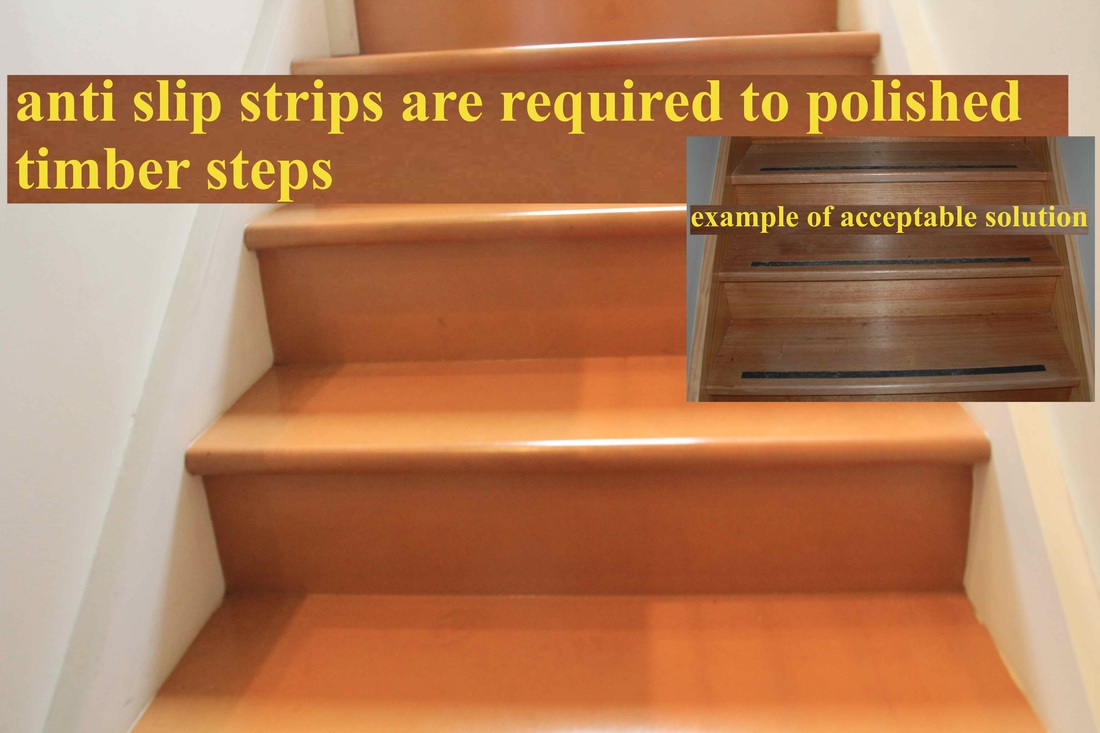
Most people would not know that polished timber stairs are injury risk because a person could easily slip and get seriously hurt. This is why BCA has requirement that the treads must be finished in non slip materials. Guess what? Many people don’t know or don’t care   and many building inspectors are not much better. We have inspected dozens of homes passed whilst defective and risky to occupants.
Picture
Nothing ever happens but when something does everyone runs for cover. It wasn’t me!

If falling and breaking your hip is not bad enough, imagine a visitor doing that and then suing you for damages. You could lose everything you have plus the shirt on your back.

So if you think you are saving money by skipping competent building inspection or by paying cheaper price to someone with suspect expertise, then you could be gambling with a lot more than you think.

5 Comments

    Author

    My Property Inspections

    Archives

    July 2025
    April 2014
    January 2013

    Categories

    All
    Building Inspections
    Injury
    Polished Timber
    Safety
    Stairs

    RSS Feed

Sitemap  | © My Property Inspections